1862 June 28 Cloud’s Mill, Pa.

[from the “War Journal” of George Hazen Dana, of the 32nd Massachusetts, a compilation of his letters and field notebook]

                                                 Cloud’s Mills, Pa.
                                                 June 28th 1862.
          As you see, we have moved about fifteen miles
to the southward of our old quarters, where we have
about 18,000 men to be commanded, probably.  Gen.
Sturgis and more regiments expected soon.   We
marched all the way here, and immediately on arrival
I was detailed as Officer of the Guard, which kept me
up all night, so I’ve not felt much like writing since.
My great trouble here is the impossibility of keeping                                                                                 
clean, as the fine powdered dust under the grass seems to
rise, even without any wind, and cover everything.

[transcript by Mary Roy Dawson Edwards]

MSS 5130                                  

1862 June 28 Chapel Hill, N.C.

[from the diary of Eliza Oswald Hill, refugee from Wilmington, N.C.]

Saturday –Cloudy & gloomy–Just in unison with my feelings
The Richmond dispatch of the 27th tells of a battle going on–& much less
of life–Major General Hill at 3 o clock precisely crossed the Chickahominy–The
Yankees seemed perfectly aware of  his coming.  General Hill with 12000 men
engaged the whole of McClennans forces until night put an end to the unde
cided contest.  General Branch did not reach there until nightfall–Du-
ring the whole time of the contest large reinforcements were passing the Chickaho-
miny under General Lee.  But none of the forces engaged in the gattle were un
der fire–General lee did not reach MechanicksVille untill 9 oclock at night
when the battle was over–General Hill is the Hero of Williamsburg He was
then a Brigadier & won on the field his title of Major General. & the battle of
yesterday he displayed in the highest degree all the talents of a commander
with the exception of proper caution for his own life which he exposed from the
first shot to the last with the recklessness of a trooper.  The Regiments enga
-ged were the 14th 1st Louisana[sic] The 4th 3d & 2nd Georgia. The force being
under the command of General A R Wright–This force was supported in the
engagement by a portion of General Ransom’s brigade consisting of the
48th & 28 North Carolina commanded by Colonel Rutledge–The Centre
of the enemy was attacked first driving the pickets in. The 1st Louisana[sic] made
a brilliant charge encountering 3 regiments of the Enemy on the right
of the road—This gallant Regiment & the 22d Georgia fought the enemy’s centre
for several  hours & when forced to retire fell back in good order–On the left
Colonel Rutledge led the advance with his regiment supported by the 3d Geor-
-gia on the extreme right as well as in the centre the fighting was extremely
fierce. This portion of the field being gallantly contested by the 4th Georgia which
3 times repulsed the enemy & was supported by Colonel Hills 48th N Carolina
During the engagement the Enemy brought up 2 pieces of artillery from which our men suffered
                                                                                                                     badly
Received a letter from Tom to day which caused me low spirits to think he is again
a private–Mr Mason, whose thro recommendation he obtained the appoint
ment of Ordnance Sergeant & whom to be with he accepted it–Having
asked to be relieved from his office which was over Tom–Tom has also
determined to ask the Colonel to relieve him too & return to his
situation only Mr Mason wished him to take it which he did
to be near  him & so far he says they have had a pleasant time together
[“]But as Mr Mason has determined to leave & I will be alone here amongst
strangers & an uncongenial set I think it best to go back to my
Regiment”– He says further if they would allow my wagon to stay with
the Regiment–I would still hold this office. But they will not–
He mentions the death of a Mr Collins–once Overseer for Liz & the mar
riage of Miss O Kearney a great favourite of  his with Mrs Andrews’
oldest son–a minister.  Jimmie Andrews married Miss Thomas month
ago–They ought both to be where my sons are, fighting for their
Liberty–Their homes –& their families.  I answered Toms letter but
dont know when he will receive it.

Tom= her son Thomas Hill of the  18th Mississippi Co. K (Burts Rifles)
Mr. Mason= Captain James M. Mason, her future son-in-law
Liz= Elizabeth Branch Hill, daughter of North Carolina governor John Branch and her widowed daughter-in-law

MSS 6960

x

1862 June 28 Camp on Flat Top Mountain, Va.

[from the diary of James Dinsmore Templeton, private and musician in the 23rd Ohio]

Saturday, June 28, 1862

Did not practice
after Guard mounting
as it threatened rain
Practiced this afternoon
have been writing
a little
Went in with Gillett
Charlie & Swett and
got a hay floor are
getting it [?]
at the Hospital
Heavy rain passed to
the southward
no rain of any
consequence here
Showers last night
Arthur got annother
Bell Tent–he & Fox
occupy it
Had Tibb pull new seat
in my old pants

MSS 10317

1862 June 28 Camp Jones, Flat Top Mountain, Va.

[letter of James Dinsmore Templeton, musician and private in the 23rd Ohio continues]

June 28th  We are not practicing
this forenoon as it rains a little
and I will write to you
We have now been here
over a month and it is
difficult to tell how much
longer we will remain Some
think 30 days at least.  there
is an impression among several
of the officers that this is our
last camp in Va–they think
we will go into Eastern Tenn
and join with Buell
From a Telegram last night

[page 3]
we learn that the
combined forces of Banks
Fremont & Shields are
uinted and placed under
the Supreme Comd of Pope
to be called the Army of
Virginia. what disposition
will be made of this
position of the army is hard
to tell at this time. and
from past experiences I guess
it is useless to conjecture
the scenery around us
is very grand  I wish you
were here it see it
A few mornings ago I
borrowed the Col- field Glass
and went up to the highest
peak of the mountain
Words would fail to
express the grandeur of the
scene.  I only wish I was
able to sketch, had I known

[page 4]
two years ago that
I would pass through such
a country as this I should
certainly have spent six
months at least to acquire
that accomplishment for I
would now be amply
repaid as I now write
sitting outside the Tent I
see the mountains sweeping
away to the southward
in great billowy swells
far as the eye can reach
away to the Southeast
a depression in the
mountain rage between
the East River & Butt Mounts
marks the passage of
the New River called the
Narrows the place is a
strong natural position
now in possession of the
rebels where they ar[e] strongly

[page 5]
fortified  We passed
through there on our
way to and from Giles
the passage is rather a
remarkable one being only
wide enough for the passage
of the river the road being
constructed at the base
close to the water the
mountain  the mountains[sic]
on either side appears as
though they had once been
united but at some
subsequent period had
by some great convulsion
been separated for the
passage of the river.
the sides are very abrupt
riseing almost perpendicularly
to a great highth  and on
either side a coresponding
strata of rocks [cropp?] out
and incline from the base

[page 6]
to the summit at an
angle of about 60 deg’s
the different strata of earth
and rocks are qutie clearly
defined here and would
afford a study for a
Geologist
Whilst I write a rain-
storm is sweeping along
in the distance obscuring
a portion of the mountain
scenery whilst in front
of it the sun is throwing
its lights and shadows
upon the mountain sides.
the contrast is very strikeing
and fine

[Templeton’s letter will conclude on the 29th]

MSS 10317

its

1862 June 28 Staunton, Va.

[from the diary of Joseph Addison Waddell civilian employee of the Quartermaster Dept.]

Saturday, June 28, 1862.
Several dispatches at 10 o’clock last night, stating 
that the enemy had been driven back seven miles, 
and our troops still pursuing. A dispatch to-day 
says the battle is still going on, that we have cap-
tured a large number of prisoners and many small 
 arms. Cannonading heard again this morning.

[transcription by the Valley of the Shadow project]

MSS 38-358

1862 June 28 Louisiana

                                      June 28th  1862

           My Dear Boys

                              After a long interval
of silence on your part, my anxiety has
been relieved concerning you by the receipt
of Pauls letter and day before yesterday of
yours dear Alex, I [?] so , lest you might
be sick that I was half tempted to go and
see for myself, had my family been well
I might have done so.  Nannie and her
husband have had a siege of it but are both
much better now, they with my sister will
go to the Falls of St Anthony as soon as their
health will permit, I shall remain at home
Nan and I will have a lonely time, but,
cannot consent to go any further from my
darlings, what would I not give to have
you two dear boys with me, not a day
passes but you are tenderly thought and

[page 2]
spoken of, reminiscences of our European
tour are rarely refered to that your name
Alex is not mentioned, on a pleasant
afternoon when about to ride out Nan
will say, I know poor Alex often thinks
of Cadet’s query of ladies will you like
to go to the “Pines to day”  how I wish he
could be with us now, or when the fine
fruits or gumbo are brought on the
table we “wish the dear boys had some
of it,” by the bye I have made some nice
preserves for you and will send you a box in
the early part of the week, & will try to let
you have it by the 4th of July , a novel thing
it will be for Americans to celebrate the
anniversary of their independence in
prison, but look out for the box you
will not probably enjoy its contents the
less because you are where good things
are scarce,  I am glad to hear you are
both bearing your prison life in so
soldierly[?] a manner.  I hope you did
not fail to write to your mother by the

[page 3]
released surgeons you spoke of
they will be permited to take open
letters, it would have been such a direct
opportunity; have they gone south: if so by
what route?  I heard of your friend, W
he was well and in high favour, being recom
-mended for promotion, and transfer into
the regular army, by five of the most prominent
officers in it, a Federal officer who saw
him on the battle field at Elkorn says
his gallantry on that occasion attracted the
attention of the officers of their side and
said he deserved promotion on the field.
The City is dull, nothing breaks the monotony
except an occasional pic-nic, even they
are few and far between.  Tom sends his
love as does Nan who says she intends
to write to you soon.  do either of you
need any thing?  remember me to  Col.
Battle; when you get the box invite him to
lunch. Each and every one join in
much love to both of you.  I remain dear
boys most affectionately
                                      yours

unsigned letter to Alexander and Paul de Clouet

The de Clouet brothers were sons of Confedrate congressman Alexandre Etienne deClouet of Louisiana.  Both were in the 1st Field Battery, Louisiana Artillery which served in New Orleans until the fall of that city.

MSS 9564-a

1862 June 27 Lynchburg, Va.

[from the diary of William M. Blackford,  bank officer and former diplomat, with five sons in the Confederate Army]

Friday 27  The great battle has begun
It opens auspiciously for our cause
The enemy are routed on their right
wing–driven back for miles–all
their batteries carried.  Every thought
so far as heard from favorable–but
it is too soon perhaps to crow. We
are not yet out of the woods–Went
down to meet Lanty who informed me
on the back of a letter that he wd
arrive this evening.  Missed him at
the Depot.  Saw two cars follow
with 76 prisoners- mostly wounded badly.
They were left by Fremont at Harrison-
burg on his retreat coming home
found Lanty had brought Mary
Jane with him who has grown
much and slenderer since I saw her
Lanty looks thin & not wel.  He as
ked permission to invite for  to supper
Mr. Gildersleeve Greek prof of the University
and three young gentleman of the 1st
Maryland Regt.  Their names were
Williamson, Murray, & Laird–all
gentleman born & bred, and distinguished
for polish of manners & high intelligence.
Williamson is a man of fortune–was edu-
cated in Europe & has [fine?] [talent?]
Muray is the son cousin of the gallant
Lt Murray who distinguished himself
some years ago on board the San Francis
co at the time of her wreck.  In what
other servie could you find four such
young men as these & Lanty ser-
ving in the ranks.  I am struck with
the young men from Maryland.  They
beat ours in manners & dignity of
character–How very inferior seems
Gildersleeve to this youn man William
son–They had been in the same Univer
sities in Germany though not at the
same time.  They staid until near 11
and made themselve very agreeable
–went down street to hear the news
but [?] at nothing.  Ben retu
-ned & staid all night with Lanty.

MSS 4763

1862 June 26 Fredericksburg,

Thursday Eveng Fredericksburg, June 26

Dear Sir
I avail myself
of a kind offer to take my letter
to Baltimore to write you
a few lines.  But we have
written you so many letters
and have non in reply
that I have thought it
best not to write more.
We are living  in Dr George
Carmichael’s house in
Fbg. pleasantly enough
Fitz Taylor’s illness alarms
us greatly for the result.
I fear he can not recover
To day I have been busily em=
ployed in the meadow
saving the crop of grass=
A great undertaking it is
with no one to do it.

[page 2]
We moved here this week
thinking it might improve
Father, and then conveniences
of life are greater here.
Write soon and direct
your letter care of Capt
Mansfield or Provost marshall
of Fbg  It will come safely

unsigned letter to Dr. William Forbes of Philadelphia passed across the lines from his family in Fredericksburg

MSS 15127

1862 June 27 before Richmond, Va.

[from the diary of Jonathan B. Hager of the 14th U.S. Regulars as copied and annotated by him at a later date]

June 27  A day never to be forgotten.  It is impressed
             upon my mind by virtue of its heat, its hard
             marches, its privations of food & water, its great
             dangers.  The battle of Mechanicsville the day
             before was an attack by Jackson upon McCall
             This General during early this morning fell back
             & the army took position near Gaines Mill and
             Cold Harbor.
                  We left bivouac before day this morning,
             marched back to our old Camp, where the men
             got their knapsacks.  It was evident to us, that
             we were going to vacate the ground, which had
             been our home for a month.  Our Sutler not
             having transportation for all his goods, they
             had to be destroyed, and champaign flew
             around in unlimited quantities.  This with
             hard bread constituted our breakfast that
             morning.  An immense pile of Commissary
             stores Bread, Salt, Pork, Beef, Whiskey, Candles,
             Soap, Beans were all set on fire.  It was a
             sad looking sight and indicated a precip-
             itate retreat.  Early we took up our line of
             March by Gaines Mill.  Gen Porter seemed to
             find it difficult to find a position that
             suited him and we marched & countemarched
             all over the Country, up hill & down, through
             water, mud & dust until we were nearly
             exhausted.  Finally about 10 a m. we halted
             and lay in the hot sun for an hour.  Not
             the vestige of a shadow and officers not per-
             mitted to leave their companies. We made up
             our minds to suffer all things this day and
             and [sic] could certainly endure this.
                About 12 oclock Capt. OConnell gave us the
             order to load.  The only speech he made was this
             “Now Men in the fight we are about to have
             all I have to say is to keep closed, fire low
             & do not become too much excited”  Whatever
             may have been our thoughts before, a battle
             looked imminent here.  And yet we were
             in much doubt whether it would come.  We
             had been called out so often & had returned
             without seeing a rebel, that we were almost
             faithless.  We knew however that rebels were
             near now & this certainly the nearest we had
             ever been to them.  Our position at this time was
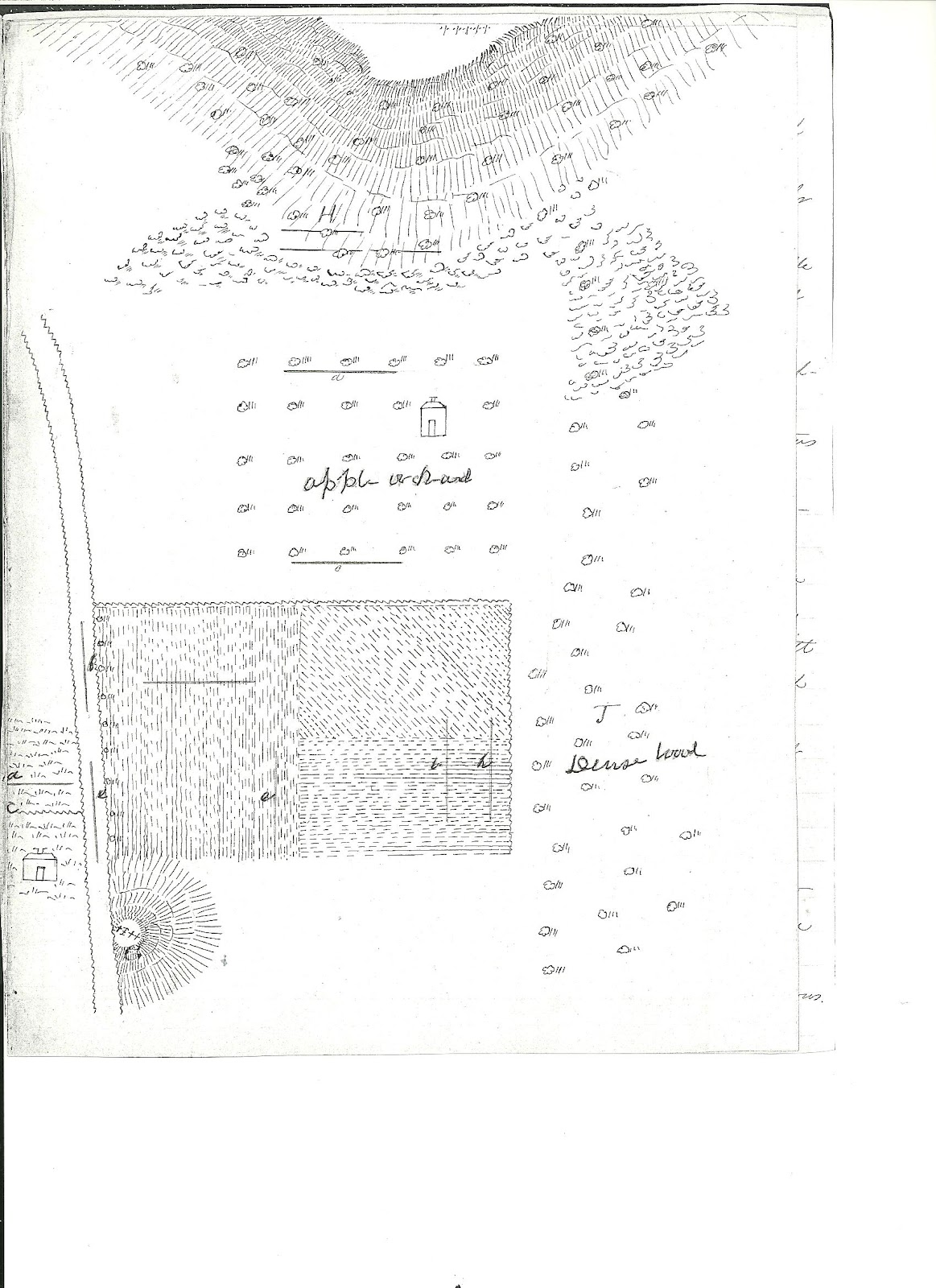
             at “a” (see diagram).  We then moved position to
             the road or lane at “K”.  Here we awaited the
             Enemy.  We had not long to wait.  about 1 P.M.
             he was seen on the hill beyond the apple or-
             chard where he had established a battery.
             This battery attempted to shell us at our po-
             sition “K”.  In order to get out of his line of fire
             we were ordered to “b” across the cornfield  some
             several yards.  We went across this
             field in line of battle in quick time only &
             in splendid order, under a heavy shelling.
             When about the point marked “e” I saw a shell
             coming towards me, being almost in a direct
             line.  I saw it distinctly.  It looked horrible and
             tremendous in size.  I mad a very quick cal-
             culation.  I calculated that if I took one more
             step that shell would hit me.  Prudence indeed
             seemed to dictate that I should halt, and
             give it the right of way.   I did so, all this was
             as quick as thought, & had to be–The shell struck
             at the feet of the color corporal, the man next
             to me but one in the rear rank.  I saw him
             fall but had not time to see if he was hurt.
             I learned afterwards that the shell did not
             hit him, but that the concussion threw him
             and two or three others to the earth.  It did
             not burst.  If it had this diary would not
             perhaps have been written.
                 The battalion pushed on under this fire
            until it reached the position “b” near the edge
            of a dense wood and a fence out of the line
            of fire from the rebel batteries.  We lay here
            until nearly 3 P.M.  In the interim we sent
            pickets through woods in our front to give
            us notice of the approach of the enemy from
            that direction.  We also sent the left company
            in the direction and into the apple orchard.
                Towards 3 P.M. we could see the skirmishers
           of the enemy advancing towards us on the
           hill beyond the orchard in handsome style.
           It was not long before our skirmishers were
           engaged & they fell back to their regiment, not
           however without gallantly contesting the ground.
               The 14th charged front & advanced to meet them
          and took the position marked “c” when the
          battle commenced.  The rebels were in a grove of
          small pines marked “H” & the fire became lively
          Almost the first fire my best corporal was
          killed.  The fight here continued with much of any
          for about two hours with an occasional intermission
          We not only maintained our ground against
          their furious assaults, but drove them twice out
          of the woods to the hill beyond where we could
          see them running for dear life.  These were
          interesting moments and if our men had not
          been checked by us would have rushed into the
          very arms of the whole rebel army.
               The rebels, however, as soon as one line was
          forced back would send in another to take its
          place. Thus we had to fight tow or three sets
          of fresh troops.  We would have maintained
          our position at “c” until night (we had ad-
          vanced twice to “d” & fell back to “c”) but the 3rd
          Infantry which had been fighting at the point
          “p” on the death of Major Russell, Commanding,
          fell back without giving us notice when
          the rebels then directed their fire upon the 14th.
          We were thus between two fires and we were com-
          pelled to make a flank movement and take up
          our old position at “b”.  Our battery drove the
          rebels from “H” and they left the woods at “J” for
          which we were thankful as we were greatly in
          need of rest & water.  After laying here awhile
          we fell back to point marked “e” under the crest
          of a slight rise in the ground where we lay.
          Here we sent a couple of men from each Comp-
          any with nearly all the canteens, for water.
          They were taken prisoners, so we lost our canteens
          and didn’t get any water.  We lay here some
          length of time, I felt perfectly secure suppo-
          sing we had skirmishers in the woods in our
          front. The rest was grateful though it was in
          a ploughed field and under a broiling sun.
          I felt thankful I had escaped being hit with
          the murderous lead & iron of the enemy though
          so many had fallen around me and was
          thankful to be any where else. I had not
          yet finished my part of the fight.
          In the midst of a profound quiet we were
          startled by a tremendous volley of musketry
          from those very woods in our front not seventy
          five yards distant, then came another and
          another. The bullets whisteled [sic] in terrific
          proximity to our heads as we hugged the furrows.
          The time though but a moment seemed an age
          Several of our officers & many of our men were
          wounded & Killed here.  All at once, during a
          momentary lull in the firing, came the order
          from OConnell to rise & retire stooping.  As
          we  retired the rebels came out from their cover.
          We had not gone far when we faced about
          and gave them a volley which somewhat
          checked their advance: then our battery at
          “G” poured into them grape and cannister. They
          still advanced in masses under this terrible
          fire.  We had given them several volleys before
          we got back to the lane in the position marked “f”
          where we made a stand.  Here we fought in the
          twilight keeping this force in check when we were
          relieved by a volunteer regiment (the 16th N.Y.)
          which came into the fight with a tremendous
          cheer, nearly breaking our line.  They received
          about one volley from the enemy when they
          retired in great disorder.
              It being now dark, the battle was nearly
         over.  An occasional volley fired on suspicion
         and an occasional shell were the only evidences
         that the two armies had just been engaged in
         deadly conflict.  Night with it charitable
         mantle covered the horrible scene.  Our army
         which was composed of about Twenty seven
         thousand troops, held in check about Seventy
         thousand of the enemy.  Our task was well
         done.  We were selected to interpose between the
         rebels & the rest of the Union Army.
            Gen. McClellan finding it impossible to per-
        suade the Government to let McDowell u-
        nite with him on the right, necessarily was
        compelled to shorten this line, and as the attack
        was made, while the rest of the army with
        its immense trains of artillery & supplies
        of all kinds crossed the Chickahominy–
        That night  our portion of the army which had
        been fighting all day, also crossed, when the
        bridges were blown up & we lay down at
        daylight to take some rest.
     MSS 9044

  

1862 June 27 near Richmond, Va.

[from the diary of Sgt. Z. Lee Gilmer of the Albemarle Rifles,  Co. B. of the 19th Virginia]

27th June
    As soon as we could see I
saw long black lines of troops
stretching from hill to hill
from woods to woods & in Brigade
after Brigade they slowly but
surely advanced down the river to
the field of carnage Sweping[?]
that cowardly foe before our
impenitrable ranks leaving
the ded & wounded behind. This
I thought was the most sublime
sight I have ever witnessed. But
before the fireing was very warm
here at McCanicsville this morn
[hole in paper]  the Federals soon gave way & we
poreing a warm fire into them
as they skedaddled before us, for
we had driven them from the bridge
from McKanicsksville & from many
brestworks which our men advanced
upon in the most perfect order
& bravest manner.  In this way we
were closley pressing them through
the day fireing upon them all
the time until about one or two
oclock when I entered the battle of
        Gainsmill
Just before going in to that
dredful fight we saw Old Jackson
pass on our left going to
the rear of the enemy at this
time we were resting at Gains
dwelling here I laid down &
got a short [s]leep.  But about 2
O’Clock we made the attack on
the enemy right wing where
we found them strongly intren
ched in the woods.  we charged
upon their works they in the
woods & we in the fair open
field, we charged until within
150 yds of their works when
we stood & fired very severe &
a most heavey fire was pored
into us, for Pofers[sic] Division here
was strongely intrenched–Our
men here fell thick & fast
but stood as firm as the
rock of ages, here fell Gen
Pickett my major & many
brave & gallant officers.  soon
we were ordered to charge & drove
the enemy from their behind
their works.  here my Brigade
was relieved & I entered the
fight with Pryors (Roger A)
& in advancing across the field
in a very short distance not more
than 80 yards from their battery
& a very severe fire, I received my
wound which the Surgeon’s
pronounced mortal for two days
It was just dark when I received
my wound.  I was then borne
to the field officer Hospital
where I remained until the
next day

[although dated the 27th, Gilmer’s diary appears to have been written some days to weeks later]

MSS 4459