1862 October 23 Chapel Hill, N.C.

[from the diary of Eliza Oswald Hill, refugee from Wilmington, N.C.]

Wednesday 23  Mrs Walters has just received a letter from Dr Anderson
telling of the suffering in Wilmington–He says they are really star
ving there. He has been sick–But is up again. The fever is in Mrs Walters’
[lap?] –3 servants have had it but none have died–Poor Hester I can
hear nothing of her.  My face being better I went out to breakfast
this morning–It is so cold I think we must have had a frost
Eliza being away I rise at 6 o’clock & ave my room all put in
order before breakfast–giving Kay time to sew for herself–

MSS 6960

1862 October 23 Staunton, Va.

[from the diary of Joseph Addison Waddell, civilian employee of the Quartermaster Dept.]

Thursday, Oct. 23, 1862
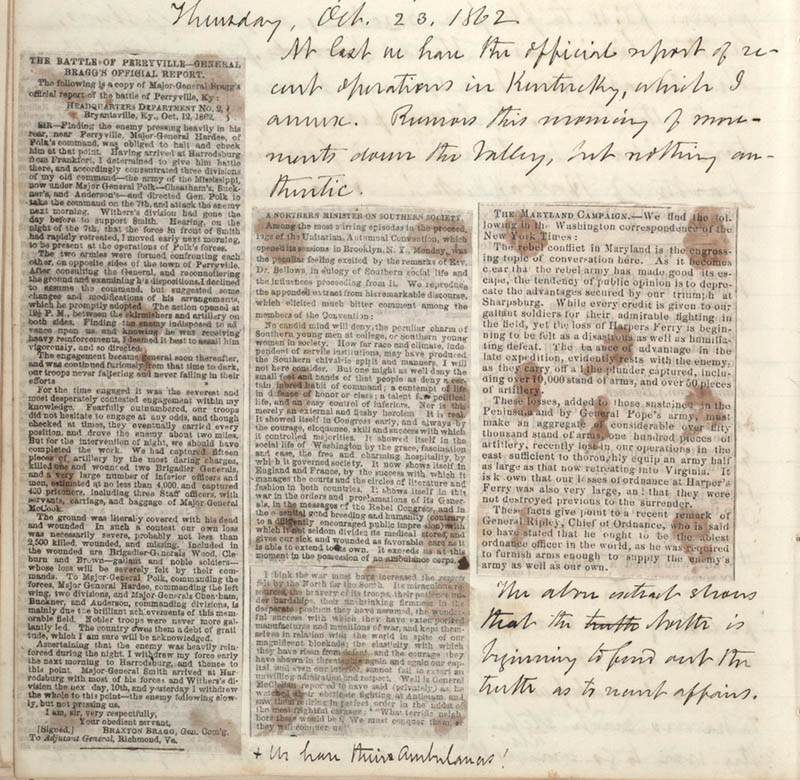
At last we have the official report of recent operations in Kentucky, which I annex. Rumors this morning of movements down the Valley, but nothing authentic.
We have their ambulances!
The above extract shows that the North is beginning to find out the truth as to recent affairs.
“The Battle of Perryville— General Bragg’s Official Report,” “A Northern Minister on Southern                         Society,” and “The Maryland Campaign”

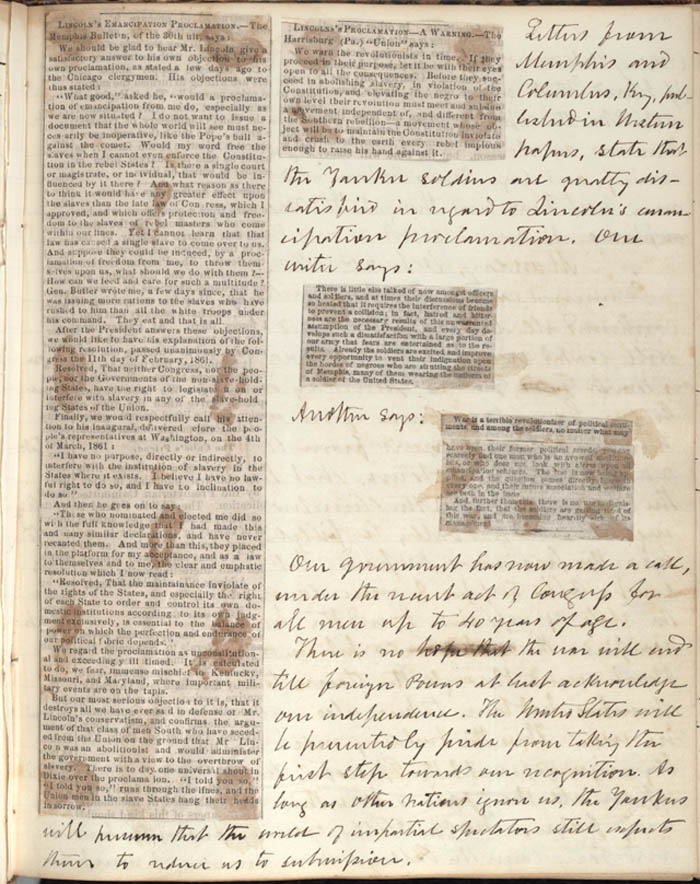
Letters from Memphis and Columbus, Ky, published in Western papers, state that the Yankee soldiers are greatly dissatisfied in regard to Lincoln’s emancipation proclamation. One writer says:
Another says:
Our government has now made a call, under the recent act of Congress for all men up to 40 years of age.
There is no hope that the war will end till foreign powers at least acknowledge our independence. The United States will be prevented by pride from taking their first step towards our recognition. As long as other nations ignore us, the Yankees will presume that the world of impartial spectators still expects them to reduce us to submission.
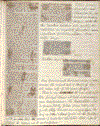
“Lincoln’s Emancipation Proclamation,” “Lincoln’s Emancipation Proclamation—A Warning,” and [Untitled]
THE BATTLE OF PERRYVILLE—GENERAL BRAGG’S OFFICIAL REPORT
The following is a copy of Major General Bragg’s official report of the battle of Perryville, Ky:
SIR—Finding the enemy pressing heavily in his rear, near Perryville, Major General Hardee, of Polk’s command, was obliged to halt and check him at that point. Having arrived at Harrodsburg from Frankfort, I determined to give him battle there, and accordingly concentrated three divisions of my old command—the army of the Mississippi, now under Major General Polk—Cheatham’s, Buckner’s, and Anderson’s—and directed Gen. Polk to take the command on the 7th, and attack the enemy next morning. Wither’s division had gone the day before to support Smith. Hearing, on the night of the 7th, that the force in front of Smith had rapidly retreated, I moved early next morning, to be present at the operations of Polk’s forces.
The two armies were formed confronting each other, on opposite sides of the town of Perryville. After consulting the General, and reconnoitering the ground and examining his dispositions, I declined to assume the command, but suggested some changes and modifications of his arrangements, which he promptly adopted. The action opened at 12 P. M., between the skirmishers and artillery on both sides. Finding the enemy indisposed to advance upon us, and knowing he was receiving heavy reinforcements, I deemed it best to assail him vigorously, and so directed.
The engagement became general soon thereafter, and was continued furiously from that time to dark, our troops never faltering and never falling in their efforts.
For some time engaged it was the severest and most desperately contested engagement within my knowledge. Fearfully outnumbered, our troops did not hesitate to engage at any odds, and though checked at times, they eventually carried every position, and drove the enemy about two miles. But for the intervention of night, we should have completed the work. We had captured fifteen pieces of artillery by the most daring charges, killed one and wounded two Brigadier Generals, and a very large number of inferior officers and men, estimated at no less than 4,000, and captured 400 prisoners, including three Staff officers, with servants, carriage, and baggage of Major General McCook.
The ground was literally covered with his dead and wounded. In such a contest our own loss was necessarily severe, probably not less than 2,500 killed, wounded, and missing. Included in the wounded are Brigadier Generals Wood, Cleburn and Brown—gallant and noble soldiers- -whose loss will be severely felt by their commands. To Major General Polk, commanding the forces, Major General Hardee, commanding the left wing, two divisions, and Major Generals Cheatham, Buckner, and Anderson, commanding divisions, is mainly due the brilliant achievements of this memorable field. Nobler troops were never more gallantly led. The country owes them a debt of gratitude, which I am sure will be acknowledged.
Ascertaining that the enemy was heavily reinforced during the night, I withdrew my force early the next morning to Harrodsburg, and thence to this point. Major General Smith arrived at Harrodsburg with most of his force and Wither’s division the next day, 10th, and yesterday I withdrew the whole to this point—the enemy following slowly, but not pressing us.
I am, sir, very respectfully,
Your obedient servant,
[Signed] Braxton Bragg, Gen. Com’g.
To Adjutant General, Richmond, Va.
A NORTHERN MINISTER ON SOUTHERN SOCIETY
Among the most stirring episodes in the proceedings of the Unitarian Autumnal Convention, which opened in sessions in Brooklyn, N. Y., Monday, was the peculiar feeling excited by the remarks of Rev. Dr. Bellows in eulogy of Southern social life and the influences proceeding from it. We reproduce the appended extract from his remarkable discourse, which elicited much bitter comment among the members of the Convention:
No candid mind will deny the peculiar charm of Southern young men at college, or Southern young women in society. How far race and climate, independent of servile institutions, may have produced the Southern chivalric spirit and manners, I will not here consider. But one might as well deny the small feet and hands of that people as deny a certain inbred habit of command; a contempt of life in defence of honor or class; a talent for political life, and an easy control of inferiors. Nor is this merely an external and flashy heroism. It is real. It showed itself in Congress early, and always by the courage, eloquence, skill and success with which it controlled majorities. It showed itself in the social life of Washington by the grace, fascination and ease, the free and charming hospitality, by which it governed society. It now shows itself in England and France, by the success with which it manages the courts and the circles of literature and fashion in both countries. It shows itself in this war in the orders and proclamations of its Generals, in the messages of the Rebel Congress, and in the essential good breeding and humanity (contrary to a diligently encouraged public impression) with which it not seldom divides its medical stores, and gives our sick and wounded as favorable care as it is able to extend to its own. It exceeds us at this moment in the possession of an ambulance corps.
I think the war must have increased the respect felt by the North for the South. Its miraculous resources, the bravery of its troops, their patience under hardships, their unthinking firmness in the desperate position they have assumed, the wonderful success with which they have extemporized manufactures and munitions of war, and kept themselves in relation with the world in spite of our magnificent blockade; the elasticity with which they have risen from defeat, and the courage they have shown in threatening again and again our capital, and even our interior, cannot fail to extort an unwilling admiration and respect. Well is General McClellan reported to have said (privately) as, he watched their obstinate fighting at Antietam, and saw them retiring in perfect order in the midst of the most frightful carnage: “What terrific neighbors they would be! We must conquer them, or they will conquer us!”
THE MARYLAND CAMPAIGN.—We find the following in the Washington Correspondence of the New York Times:
The rebel conflict in Maryland is the engrossing topic of conversation here. As it becomes clear that the rebel army has made good its escape, the tendency of public opinion is to deprecate the advantages secured by our triumph at Sharpsburg. While every credit is given to our gallant soldiers for their admirable fighting in the field, yet the loss of Harpers Ferry is beginning to be felt as a disastrous as well as humiliating defeat. The balance of advantage in the late expedition, evidently rests with the enemy, as they carry off all the plunder captured, including over 10,000 stand of arms, and over 50 pieces of artillery.
These losses, added to those sustained in the Peninsula and by General Pope’s army, must make an aggregate in considerable over fifty thousand stand of arms, one hundred pieces of artillery, recently loss in operations in the east sufficient to thoroughly equip an army half as large as that now retreating into Virginia. It is known that our losses of ordnance at Harper’s Ferry was also very large, and that they were not destroyed previous to the surrender.
These facts give point to a recent remark of General Ripley, Chief of Ordnance, who is said to have stated that he ought to be the ablest ordnance office in the world, as he was required to furnish arms enough to supply the enemy’s army as well as his own.
LINCOLN’S EMANCIPATION PROCLAMATION.—The Memphis Bulletin, of the 30th ult, says:
We should be glad to hear Mr. Lincoln give a satisfactory answer to his own objection to his own proclamation, as stated a few days ago to the Chicago clergymen. His objections were thus stated:
“What good,” asked he, “would a proclamation of emancipation from me do, especially as we are now situated? I do not want to issue a document that the whole world will see must necessarily be inoperative, like the Pope’s bull against the comet. Would my word free the slaves when I cannot even enforce the Constitution in the rebel States? Is there a single court or magistrate, or individual, that would be influenced by it there? And what reason ss there to think it would have any greater effect upon the slaves than the late law of Congress, which I approved, and which offers protection and freedom to the slaves of rebel masters who come within our lines. Yet I cannot learn that that law has caused a single slave to come over to us. And suppose they could be induced, by a proclamation of freedom from me, to throw themselves upon us, what should we do with them? How can we feed and care for such a multitude? Gen. Butler wrote me a few days since, that he was issuing more rations to the slaves who have rushed to him than all the white troops under his command. They eat and that is all.
After the president answers these objections, we would like to have his explanation of the following resolution, passed unanimously by Congress the 11th day of February, 1861.
Resolved, That neither Congress, nor the people, nor the Governments of the non-slave-holding States, have the right to legislation on or interfere with slavery in any of the slaveholding States of the Union.
Finally, we would respectfully call his attention to his inaugural, delivered before the people’s representatives at Washington, on the 4th of March, 1861:
“I have no purpose, directly or indirectly, to interfere with the institution of slavery in the States where it exists. I believe I have no lawful right to do so, and I have no inclination to do so.”
And then he goes on to say:
“Those who nominated and elected me did so with the full knowledge that I had made this and many similar declarations, and have never recanted them. And more than this, they placed in the platform for my acceptance, and as a law to themselves and to me, the clear and emphatic resolution which I now read:
“Resolved, That the maintenance inviolate of the rights of the States, and especially the right of each State to order and control its own domestic institutions according to its own judgment exclusively, is essential to the balance of power on which the perfection and endurance of our political fabric depends.”
We regard the proclamation as unconstitutional and exceedingly ill timed. It is calculated to do, we fear, immense mischief to Kentucky, Missouri, and Maryland, where important military events are on the taps.
But our most serious objection to it is, that it destroys all we have ever said in defense of Mr. Lincoln’s conservatism, and confirms the argument of that class of men South who have seceded from the Union on the ground that Mr. Lincoln was an abolitionist and would administer the government with a view to the overthrow of slavery. There is to day, one universal shout in Dixie over the proclamation. “I told you so,” “I told you so,” runs through the lines and the Union men in the slave States hang their heads in sorrow.
LINCOLN’S PROCLAMATION — A WARNING. — The Harrisburg (Pa.) “Union” says: We warn the revolutionists in time. If they proceed in their purposes, let it be with their eyes open to all the consequences. Before they succeed in abolishing slavery, in violation of the Constitution, and elevating the negro to their own level their revolution must meet and subdue a movement independent of, and different from the Southern rebellion—a movement whose object will be to maintain the Constitution inviolate and crush to the earth every rebel impious enough to raise his hand against it.
There is little else talked of now amongst officers and soldiers, and at times their discussions become so heated that it requires the interference of friends to prevent a collision; in fact, hatred and bitterness are the necessary results of this unwarranted assumption of the President, and every day develops such dissatisfaction with a large portion of our army that fears are entertained as to the results. Already the soldiers are excited, and improve every opportunity to vent their indignation upon the hordes of negroes who are strutting the streets of Memphis, many of them wearing the uniforms of a soldier of the United States.
War is a terrible revolutionizer of political sentiments, and among the soldiers, no matter what may have been their former political creeds, you can scarcely find one man who is an avowed abolitionist, or who does not look with alarm upon all emancipation schemes. The test is now being applied, and the question comes directly home to everyone, and their future association and welfare are both in the issue.
And further than this there is no use in disguising the fact, that the soldiers are getting tired of this war, and are becoming heartily sick of its management.

[transcript of diary entry and clippings pasted in by the Valley of the Shadow project]

MSS 38-258

1862 October 22 New Bern, N.C.

[from the diary of Jesse Calvin Spaulding, Co. F., 25th Massachusetts]

Wednesday
Oct 22
One of Company G. was shot on picket
last night. Twenty of each company were
detailed to find him which they did this forenoon
He was shot through the right shoulder, and had
to have his arm taken off at the shoulder. I staid in
George Lowes tent most of the forenoon singing
and talking about farming.  He says his father
makes money farming and does not work very hard
either.  This afternoon I read in “Fowler on Memory”
We have had no drill to day, only dress parade.
There was a cavalry fellow got thrown off his
horse and hurt his head some but not very bad

MSS 11293

1862 October 22 “Eudora,” near Leesburg, Va.

[from the diary of Lt. John Tyler of Letcher’s Artillery]

 (Oct.  22nd) J’ai mal
a’ la tita ce matin, also pain in my side just
as bad as yesterday.  Sat up during the morning
feel rather better.  Miss L- sat part the morning
with me & Mr. Gregg came up to see me just before
dinner.  Heard that Geary had arrested Genl Wright.
The wind has been blowing very hard for two days past.

Mr Braden rode up to Wheatland this afternoon
and returned with the corroborated statement
of a signal success in Kentucky & Genl Bragg
marching on towards Cincinnatti [sic]; he also
brings word that the Yankees have all re-
-tired to Harpers Ferry & released Genl Wright.
Miss L- has taken a ride this evening over
to Mr Millers,  Jas. accompanying.  Mrs P-
& Jeannette passed part the afternoon with
me.  Miss L- has returned.  Mr Gregg sent me
over a pair of Partridges, one of which Miss L-
broiled very nicely for my supper.  Finished 4th
Vol. of Macaulays England ce soir.  Miss L-
spent the evening in my room.

[transcript by Mary Roy Dawson Edwards]

MSS 6150

1862 October 22 Culpeper County, Va.

         
                         Oct. 22nd 1862         
                                 Culpepper Co.   
My Dear Mother,
                              The dull
monotonous camp life we were
leading at Culpepper C. H. contin-
ues – tho’ a little changed the lo-
cation we are about 10 miles
from that place – having moved
several days ago – on the
R.R. just where it crosses
the Rapohannock & about
8 [miles]from the Warrenton Junc-
tion. I received father’s two
letters of the 6th & 13th 5 days
ago. Continue to direct to Culpr.
Court House. We draw our
mail thence. Occasionally
companies or regiments are sent
on the cars farther on but
they make no stay.  
     I saw yesterday 4 miles
lower down the river at
Kelly’s ford – Kelly’s Mills, the

[page 2]
place factory I believe from
which you used to get woolen
goods. There are none to be had
there now however. This
country immediately along here
on the line of march of the
enemies & our army is complete-
ly devastated – But going off
a little it is not so much so.
The houses are generally deser-
ted or if the owner is at home
only partially cultivated.  The
Rapahonnock [as spelled]  has bottoms
at least a mile in width &
covered with fine hay which
has been only partially
preserved. We get butter at
50 cents, milk & butter – milk
rather high. That These
articles are about all we are
able to purchase for love or
money. There would be no
safety whatever in sending
me any clothes now. But if you

[page 3]
have any keep them & I will
let you know when to send
them & how. I will want some
this winter – especially a pr. of pants –
these were “fixing” to make when
I was at home. I could not
carry any more clothes than I
have now even if I had them.
I will also want socks before
any- thing else & an outer yarn [?]
shirt ^ ‘ after later’ I think it probable
the jacket you made me
last winter will last this
winter.  The Democrats seem
to be carrying the north in their
elections. I doubt very much
if it does us any good – more
than probable it will do
us harm. They are at least
as much for war as the
Republicans I reckon. Here is
a fine opportunity to talk
politicks, I mean war politicks,
but letters were made not
for that purpose – I had rather

[page 4]
write & be written to about
something else. Father men-
tions the fact that the people are
quite despondent. Never was any
people so prone to despondency.
So much so that I some times
think or rather fear the
southern people are not as
brave as they might be. It
is remarkable that not with-
standing the soldiers desire
peace so much they mind a
reverse much less. I can’t tell
how much Lee’s army is suffer-
ing from want of clothes &c.
But I expect the accounts you
hear are too nearly true. But
certe [ certes or verily] the commissary is most
fraudulently administered.
     The box you sent me in still
in Richmond– I told a young man
who remained in Richmond to bring
it when he could – he will probably
do so. I also told him to open it
& destroy whatever was in it that
would injure. My dear Mother give my
best love to father, George & all.
   Farewell & affly.
               Yr. son, W. H. Perry Jr.

William Hartwell Perry of the Richmond Howitzers

[transcript by Mary Roy Dawson Edwards]

MSS 7786-d

1862 October 22 Winchester, Va.

                                         Winchester 22nd Oct 1862

My dear Cousin

                                  Your highly appreciated favor of
2nd October, enclosing also a letter from dear Cousin
Matt, reached me on yesterday.   Its delay had almost
caused me to despair of receiving a reply, and
to think that I had presumed a little too much
on a short, but to me, a most agreeable acquaintance
ship  But the free and happy style in which
you have written, at once convinces of my mis-
take, and encourages me to give your letter a prompt
reply.  The bit of sarcasm to which you refer is not
quite forgotten.  Having reflected after the letter had
left my hands that it might not be rightly un-
derstood I began to regret that I had spoken quite
so candidly–not meaning, by that use of that word,
that adhere still to the same remark; for it was not
an opinion which I held to be true.–I did not
get a chance to visit Leesburg and my many very
good friends living there.  I had to come by way
of Front Royal and this place to join my regiment,
which had just crossed into Maryland.  They par-
ticipated in the fight at Sharpsburg.  It gave
me very great pleasure to know that my friends
had not forgotten me; and from their numerous inqui-
ries and conversations about me evinced a pleasant
remembrance of me.  I hope to get there yet, as all of
my underclothing are there, and I do not know how I am to

[page 2]
do without them.  As good fortune would have
it Genl McLaws detailed me to assist in the
distribution of the army mail at the Winchester
P.O.  the P.M. seems to be quite pleased with me,
and has placed me in a No 1 boarding house,
where I have good eating and a nice comfortable
room.  If it had not been for that good luck I
would have been frozen  I suppose by this time
as I have not a single blanket.  They were stolen
from me.– I ad lost but one dear friend
in these late battles; and in loosing him I have
lost one of my best friends.  His name was Thos
Randolph–well known at the University and
at Charlottesville.  You mistake me if you think
a letter from you would not be read with inter-
est at any time by me.  Sadness and  grief might
cast their mantles o’er me yet they should never
cause me to treat with indifference or to lightly regard
the voice of a sincere friend.  Your letters will
always be read with interest, so write just as
your heart dictates.–Had I not felt very
well satisfied you had up your mind that I was
engaged to Miss M.  I do not know that I should
have been so willing for Cousin Matt, to tell you.
However I am glad you know it, for it
gives me the pleasure of hearing from you
by your own hand, whereas otherwise I probably
cold only hear of you through another.

[page 3]
You, situated as you are, can see but little of
the effects of this unholy war waged against us.
Even in this place, containing not more than
5000 inhabitants, you see at least one thousand
who have passed through the furnace of affliction
It is distressing to witness the number that are
draped in black, mourning for their dear ones lost
in this blood conflict for our independence. And
to think that the work of destruction is not yet
done, but bids fair to be still more sanguinary
and of long duration is still more distressing.  the
only basis upon which we can now found our opes
for peace, is the recognition of our country by France
and England.  I hold the opinion, as I have seen it
somewhere observed, that, if those powers shold take
that step, the Lincoln government would follow, be-
leveing they could then do so without dishonor to them
selves.  But that would be but an excuse, for that gov-
ernment is steeped and dyed in the blackest dishonor.
It is to be hoped that the defeats in the Northern States
of the Republican candidates, as in the Western states
may give the democrats, which we hope are peace can
didates, a decided majority in both Houses.  Otherwise
we may look for it, only when an exasperated people
rise up in their might, and publicly depose the tyrant
who now governs them, whose userpation of power has
not been scarcely rivaled since the days of Nero or
Dyonicius.  The day of retribution is bound to come.

[page 4]
Our armys are still in statu quo, many of our men
suffering for shoes and socks and many of them
indeed for clothing.  The Richmond Examiner says
that “they are well clothed and anxious for the next
fray.”  Now that editor has never left his sanctum to
come and behold the condition of our army, therefore
he writes an arrant and most palpable falsehood.
He could not have been informed so, unless by some
lazy Quarter-Master of the army, hence has no founda-
tion for his assertion, whatever.  What is to be our next
movement is uncertain and a mystery to every one.
Genl Lee very wisely keeps his own council . Present
state of affairs, however, indicate a backward movement,
probably to Staunton.  I judge from the evidences of my
senses, including what I see and excluding hearsay.
The sick have all been removed to Staunton and
Richmond.  Miss Mag is doing a good work indeed, in
nursing the sick and wounded, and God will richly bless
her for it.  You cannot imagine what a purity the
presence of the gentler sex seems to infuse in the
air he breathes, which before seemed to be infec-
tious and almost to stifle him.  I have been sick and
well know what it is to have some soothing hand
to cool my burning brow, or smooth my sick pillow.
The reverence and love I bear them is something
felt within the innermost recesses of the heart which
cannot be expressed in words, and inadequately in actions.

[page 5]
You say you “really envy” me of the delight-
ful time I am having in the mountains.  Do you
though?  My fair friend, if any young man were to
tell me as much and intimate that he had
the least desire whatever, to exchange with me I’d
take him up as quick he would not be able to tell
whether the sun rose in east or west.  I dont wish you
any inconvenience or that you might be at all uncomfort
able, but I would like extremely well to be in your
place.  I’d not only be comfortably situated but near
dear Cousin Matt all of the time.  I did not
see her one third enough.  I was going to say I
wished I might get a little sick so as to get there.
But that would be useless as well as sinful, for I
have been sick nearly all the time since I left
here.  To day the doctor recommended a change of
climate and water, which I shall accept soon if I
do not get better and that very soon.  I was very
unwell when I wrote to Cousin Matt a day or
two, since and wrote very gloomily I fear.
The pure mountain air is very pleasant and exhilarating
& when one has good comfortable quarters to retire
to when night sets in, it is very delightful indeed; but
when we have to recline on the bosom of our com-
mon mother, the earth, without any shelter save the
trees, and oftentimes without covering, it is then quite
the contrary, and rather trying to human nature as
well as testing ones patriotism.  When off of duty
I enjoy myself collecting specimens of flow-
ers for an Herbarium.  I have been trying to

[page 6]
make one for some time past but without success.
Tis is a good portion of the country for the study
pf Botany, but the inconveniences of camp destroy
in a great measure the interest well as the work.
  More troops moving through town in the
direction of Manassas, this morning.  If our army
moves I shall go to R. if I can.  I am the
more convinced this morning that we are going to
retreat from the fact of a large body of cavalry
going to the rear of our army, which is to pro-
tect the rear-guard.
Tell cousin Matt that I will answer her let-
ter very soon. Would do so now but fear that I
am sitting up too long.  I wrote on Monday. Feel
much better to day.  I am greatly in love with the
Virginians.   As a class there is more magnanimity  and
kindness among them than any other state that I have
ever visited–Ive visited six.  During my present
sickness, a Mr Graves, the assistant Post Master, has at-
tended me like a brother.  Such kindness as I’ve met
with from him is rarely extended by one stranger to
another.  But God is fulfilling his own word, “Cast thy
bread upon the waters: for thou shalt find it after many days.”  My
mother and father have been good to the sick and wounded at
V’burg, taking them in their own home and giving them kind
attention. Thus they have unknown to themselves been repaid
in a measure for their charity.–Please give the enclosed
letters to Cousin Matt.  She can read them, then place
them away in my valise.  My best love to all.  Let me
hear from you soon.  sincerely your friend & cousin James W.B.

letter from an unidentified soldier  and University of Virginia alumnus to a member of the McCoy family

MSS 6830-d

1862 October 22 Camp E. D. Keyes

                    Camp E. D. Keyes
                            Oct. 22 1862

Dear Father
                   Will you send me
$5.00 some time this week
We shall probably leave one
week from to day
  Buying watch & clothes has
taken nearly all my loose
change
                     I will send a list of
articles bought & prices by & by.
                     Am well & hearty.
Recd. box & shirts
            Your affectionate son
                             C.P. Morrill

Charles Plummer Morrill  24th Maine

MSS 11031

1862 October 22 between Crab Orchard and Stanford, Ky.

[from the diary of Captain William F. Hunter, Co. B., 97th Ohio]

     Oct. 22d, ’62.
At sunrise, the di-
vision returned to
camp, & after about
an hour for break-

fast, we all moved
off on the same road
we came, & marched
rapidly until between
2 & 3 P.M., when we en-
camped about half
way between Crab – Or-
chard & Stanford. All
very tired. Our divi-
sion saw no rebels
when they were in
front of our old
camp.

[transcript by Mary Roy Dawson Edwards]

MSS 10547-m